
Smart Cash Flow Management: Logistics Equipment Rental for Manufacturing Startups
Contents
Current Manufacturing Landscape in Vietnam and Cash Flow Pressures
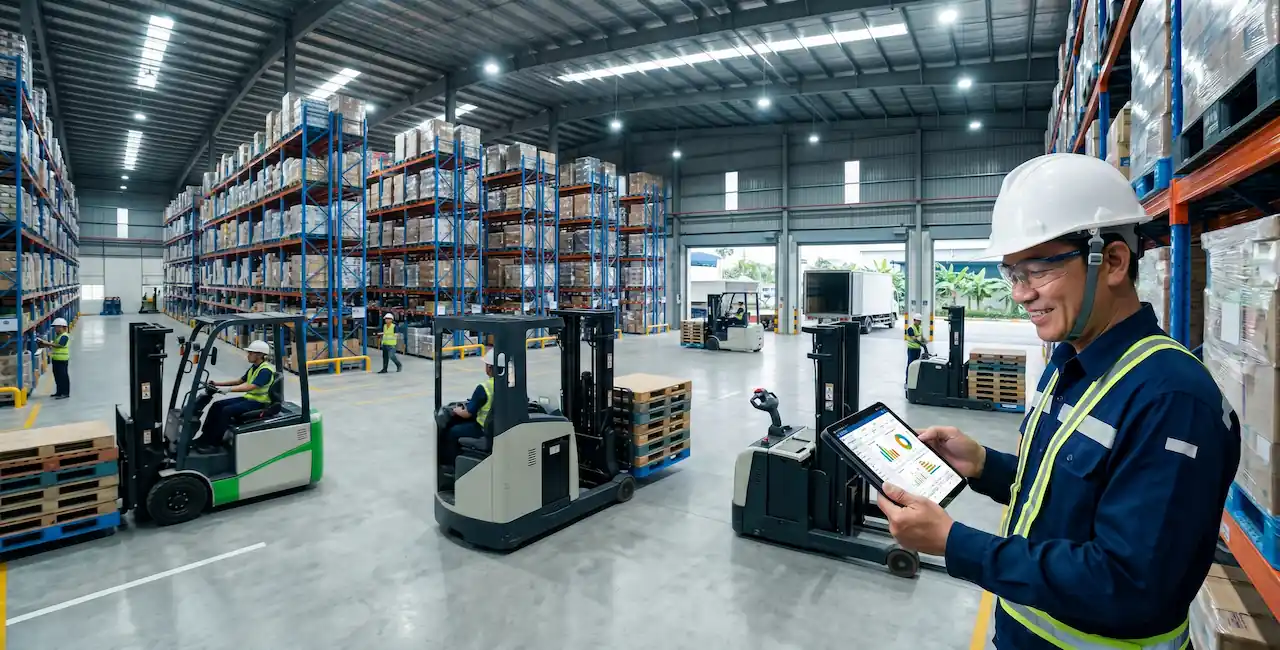
Vietnam is currently a top global destination for industrial and manufacturing startups. Driven by progressive government policies, free trade agreements, and robust Foreign Direct Investment (FDI) inflows, new manufacturing facilities are continuously popping up across key industrial corridors like Binh Duong, Dong Nai, Bac Ninh, and Hai Phong. These enterprises focus on high-growth sectors, including consumer electronics assembly, specialized automotive components, textiles, and fast-moving consumer goods (FMCG).
However, running a new manufacturing business in a volatile market requires a tight financial balancing act. Early-stage enterprises often face tight cash flows as they must allocate resources to multiple areas simultaneously, such as purchasing specialized machinery, securing raw materials, and launching marketing campaigns. Therefore, shifting from a traditional asset-ownership model to a zero-upfront-cost auxiliary equipment rental model is an optimal solution to safeguard liquidity and maximize the survival rate of early-stage startups.
Defining and Differentiating CapEx and OpEx in Logistics Asset Management
To optimize financial structures, businesses must clearly understand the nature of two fundamental costs in warehouse operations.
What is Capital Expenditure (CapEx)?
CapEx (Capital Expenditure) refers to the capital invested by a business to purchase, upgrade, or own fixed assets with long-term utility, typically over one year. In logistics management, CapEx occurs when a company buys tangible assets outright, such as plastic pallets, wooden pallets, forklifts, fixed warehouse racking systems, or constructs facilities. This expenditure cannot be fully deducted as a business expense within a single year; instead, it must be gradually depreciated over multiple financial years.
What is Operating Expenditure (OpEx)?
OpEx (Operating Expenditure) represents the operational costs incurred daily or monthly to maintain normal business functions. In warehousing and logistics, OpEx includes short-term warehouse rent, electricity bills, labor wages, equipment maintenance, and outsourcing auxiliary tools based on actual demand. These costs are deducted directly from business revenue in the current period to determine the company’s taxable profit.
Core Differences Impacting Business Liquidity
The biggest difference between CapEx and OpEx lies in cash flow flexibility and accounting methods:
-
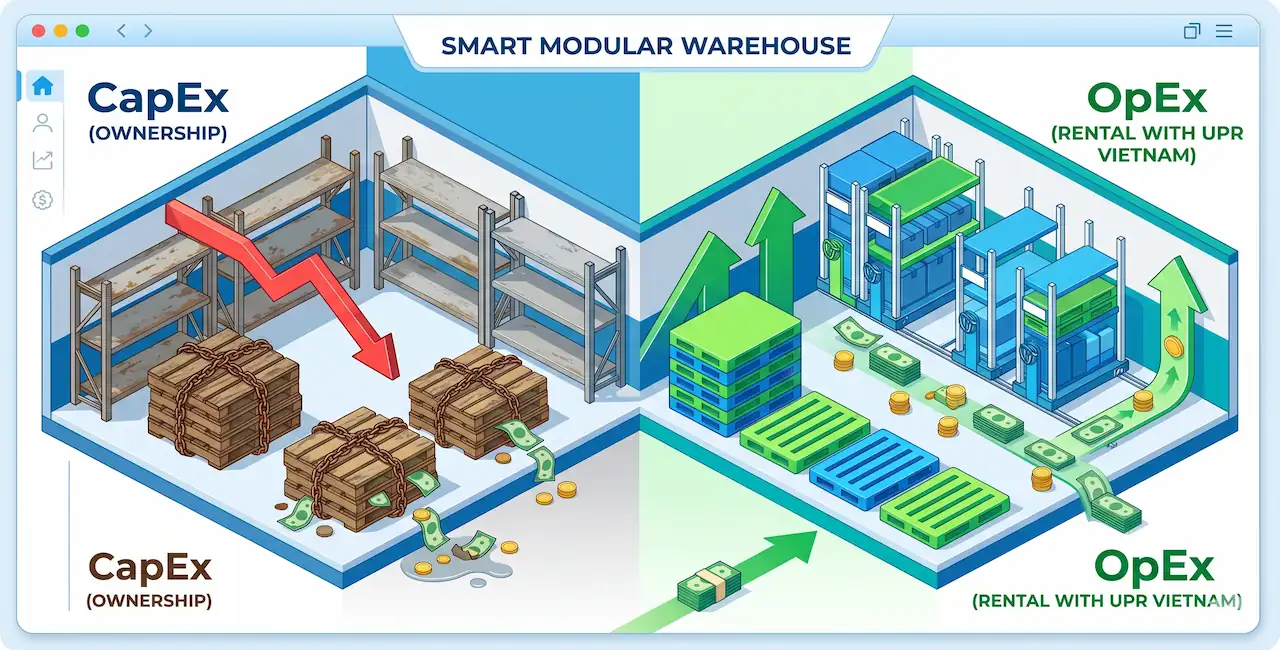
Initial Financial Pressure: CapEx requires a large upfront cash outlay during setup, reducing available working capital. Conversely, OpEx spreads costs into small, periodic payments, easing upfront financial burdens.
-
Scalability Freedom: Under a CapEx model, fixed assets purchased are difficult to liquidate or scale quickly without financial losses. With OpEx, businesses can easily scale up or down their equipment usage to match real-time market demands.
Financial Risks of Self-Investing Capital in Fixed Warehouse Equipment
When setting up their first industrial facility, many new businesses prioritize purchasing all auxiliary logistics infrastructure outright, including heavy-duty pallets, forklift fleets, and fixed racking systems. Committing limited working capital to these fixed asset purchases creates significant financial management risks:
-
Capital Tied Up in Depreciating Assets: Buying primary logistics assets outright locks cash flow into low-yield assets that depreciate over time.
-
Restricted Core Investment Capacity: Allocating funds to warehouse equipment reduces the ability to finance higher-margin categories, such as attracting high-skilled technical talent or increasing inventory reserves.
-
Wasted Capacity Due to Order Fluctuations: Since early-stage manufacturing output often relies on unstable, short-term orders, owning a fixed volume of auxiliary equipment can lead to waste, leaving assets sitting idle in the warehouse during market off-peak cycles.
Converting Capital Expenditure into Operational Expense: The UPR Vietnam Solution
UPR Vietnam’s equipment rental and open supply chain asset rotation model addresses financial barriers head-on by transforming the entire logistics infrastructure procurement process into a highly scalable operating expense.
Under this approach, newly established manufacturing enterprises do not need to invest capital to own material handling equipment. Instead, businesses can lease high-performance standard plastic pallets and modular U-Rack mobile racking systems from UPR Vietnam’s shared supply pool.
This operational structure delivers optimized benefits:
-
Zero Initial Setup Costs: Factories can go live immediately without paying upfront for equipment, only paying periodic monthly rental fees based on the actual volume of assets used.
-
Flexible Return Mechanism: When experiencing a production slowdown or a change in distribution plans, businesses can return excess rented equipment to UPR Vietnam to stop charges immediately, protecting cash reserves from inefficient fixed costs.
Strategic Benefits of the Warehouse Equipment Rental Model
Adopting an on-demand logistics equipment rental solution brings three major advantages to new factories in Vietnam:
-
Maximizing Working Capital Efficiency: Shifting logistics infrastructure from a capital expenditure to an operating expense structure helps businesses preserve critical cash. This capital is freed up to focus on core profit-generating activities, such as upgrading production line technology, product innovation, and expanding distribution channels.
-
Flexible Scalability to Match Seasonal Fluctuations: Manufacturers can rapidly scale up or down the number of pallets and storage racking systems to align with peak export seasons or seasonal market shifts. This solution completely eliminates financial losses associated with maintaining and managing idle machinery and equipment when there is no demand.
-
Minimizing Asset Management and Maintenance Burdens: By outsourcing, the burden of technical safety inspections, cleaning, routine maintenance, and repairing physical damage to equipment is fully supported by UPR Vietnam throughout the rental period. This allows businesses to streamline their logistics staff, minimize internal management costs, and focus resources on boosting factory productivity.
Financial Management Outlook for Long-Term Supply Chain Optimization
In Vietnam’s highly competitive industrial manufacturing environment, operational flexibility and financial liquidity are critical factors determining the survival and growth of a startup. Businesses cannot optimize profit margins if they continue to tie down working capital in rapidly depreciating warehouse assets.
Establishing a partnership with a professional industrial asset manager like UPR Vietnam ensures that a company’s material handling and storage infrastructure dynamically scales with actual order volumes. By standardizing operations based on a highly durable, shared asset rotation system, businesses can eliminate real estate waste, optimize internal warehouse space, and enhance competitiveness within the global supply chain.
Contact us for more information about our Pallet Rental service
Cho thuê Pallet và Kệ | Công ty TNHH UPR Việt Nam > Columns > Logistics > Smart Cash Flow Management: Logistics Equipment Rental for Manufacturing Startups
 Zalo
Zalo  Tel
Tel  Contact Us